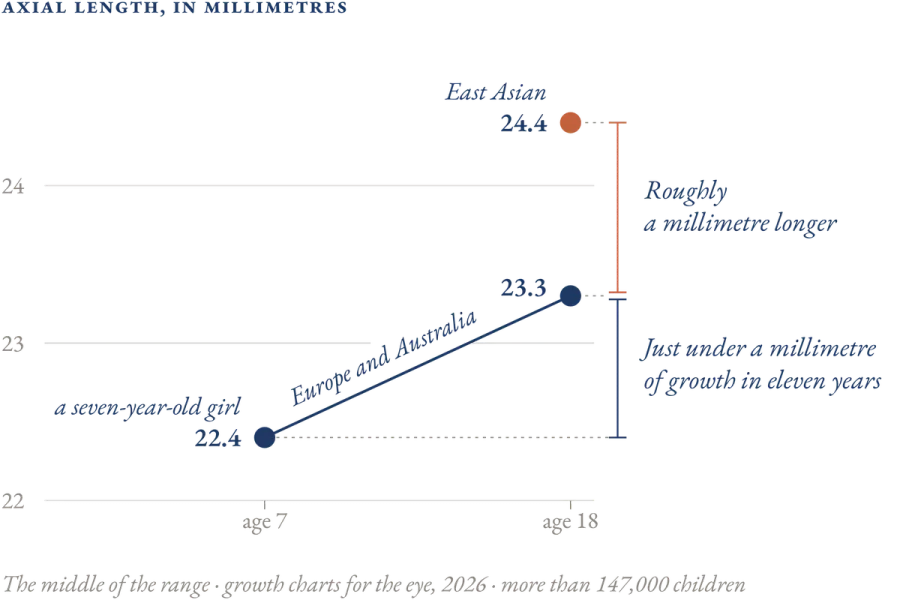
Children become short-sighted because the eye grows slightly too long from front to back. Not weak, not strained, not worn out by reading or screens: too long, by about a millimetre. Genes decide how likely that is; the shape of a childhood, how much of it is spent indoors, how close the schoolwork is held and how early the growing starts, decides how far it goes. That single fact is why the two dullest pieces of advice about children’s eyes, go outside and hold the book further away, are the two with real evidence behind them.
I am a father, not a doctor, and I lost about a year hunting for whatever was damaging my son’s eyes before anyone explained this to me. So it goes first.
Not a weak eye: an eye that has grown too long
Picture a camera whose body is slowly stretching. The lens is fine. But as the body lengthens, the sharp image falls short of the sensor, and everything in the distance blurs. That is myopia. The measurement from the front of the eye to the back is called axial length, and once you know that short-sightedness is a story about that one length, the confusing parts fall into place.
Start with glasses. A lens in front of the eye moves the image back onto the retina, which is why the world snaps into focus the moment your child puts them on. The length of the eye behind the lens is unchanged, in either direction. Glasses are the correction, not the cause, and they are not a failure.
Then the hard part, which I would rather say plainly than dress up: it does not reverse. An eye that has grown longer stays that length. Everything a parent does is about how far and how fast the growing goes, which is why the only useful time to act is early.
The eye grows in response to what it sees
Here is the hopeful part. Eye growth is not blind. In chicks, monkeys and guinea pigs, put a lens in front of a young eye so the image lands just behind the retina, and the eye lengthens until it catches up; raise the light level, and the lengthening slows.1 Evidence: LIMITED Nobody can yet describe that signal fully in a human child, and the animal work is the reason it is graded cautiously. But it is the reason daylight and reading distance have any effect at all. They are inputs to a growth system, not chores.
A note on units. Prescriptions are written in dioptres, D. Short-sightedness begins at about minus half a dioptre; minus six and beyond is called high myopia, and that second threshold is the one worth remembering.2
Speed matters more than the number: ask for the length
A healthy child’s eye lengthens by roughly a tenth of a millimetre a year as they grow. Two to three tenths a year is the signature of myopia taking hold.2 Evidence: STRONG The gap between the two is small, which is exactly why it is worth measuring rather than guessing.
Axial length can be measured in seconds, without touching the eye, and unlike a prescription it cannot be fooled by a tired or anxious child. Since 2026 there have been growth charts for it, built from measurements on more than 147,000 children, so an optometrist can show you where your child’s eye length sits for their age in the same way a clinic shows height and weight.3 Evidence: STRONG If you take one practical thing from this page, let it be a question: is my child’s eye length being measured, and where is it on the chart? A little long-sightedness in a young child, by the way, is normal; it is the room the eye still has left to grow into.4
Why it matters at sixty
Laser surgery does not undo any of this; it reshapes the front of the eye and leaves the length alone, which is something I only understood after a parent of mine had it done. A longer eye has its back layers stretched thinner over a larger space, and that is where the long-term cost sits. A 2020 meta-analysis found that the odds of damage at the centre of the retina, of retinal detachment, and of several other conditions all climb with each level of short-sightedness, steadily at first and then steeply in high myopia.5 Evidence: STRONG
Most short-sighted people never meet any of that, and glasses are not a tragedy. But the odds move with the millimetres, and one estimate changed how I think about the whole subject: every dioptre of myopia a child does not acquire cuts their lifetime risk of that retinal damage by roughly 40 per cent.6 Evidence: MODERATE Not the risk of glasses. The risk of the thing you would actually worry about. Nobody can promise to keep a child out of spectacles; the evidence says that each dioptre kept off the total is permanent protection for a person who will still need their eyes in sixty years.
Genes load the dice; the childhood rolls them
Family history matters. In one long-running American study, children with two short-sighted parents had roughly six times the odds of becoming short-sighted themselves.8 Evidence: STRONG That is odds, not fate: children with the same family history split, and what separates them is how the childhood ran. Do not buy a DNA test. Hundreds of variants are involved, and the scientists who build the risk scores say they are not ready for use on an individual child.9
The proof that the dice are not everything is in the trend. Across surveys worldwide, the share of children and teenagers who are short-sighted rose from about a quarter in 1990 to about a third by 2023, and is projected to approach four in ten by 2050.7 Evidence: STRONG A population does not change its genes in thirty years. What changed is how children spend their days, and the direction of that change is the direction a household can push back.
What moves the millimetre: daylight, distance, timing
Daylight is the brake. A 2024 Cochrane review pooled five trials in which schools sent children outside for longer: over two years about 22.5 per cent of those children became short-sighted, against about 26.7 per cent of the others.11 Evidence: STRONG Real, not miraculous, and far stronger at stopping myopia from starting than at slowing it once it has begun. Around two hours a day is the working dose, and shade, cloud, hats and sunglasses all count. The full case is at two hours of daylight.
Distance is the dial on the schoolwork. In more than 10,000 Taipei schoolchildren followed for two years, those who kept their reading beyond about 30 centimetres, and those who paused every half hour, progressed measurably more slowly.10 Evidence: MODERATE The lever is not less study but a different way of doing it, and a tablet, held closer and for longer than any book, is the same lever pulled the wrong way. How far a child should sit has the numbers.
Timing is the force nobody mentions. Myopia is a slope that runs for years, so the age a child steps onto it largely decides where they finish. In a Singapore cohort, each year earlier that myopia began multiplied the odds of ending in the high range by nearly three.12 Evidence: MODERATE The International Myopia Institute puts it this way: a one-year delay in onset is worth about two to three years of treatment later.4 That is why the measuring has to start before anything looks wrong, and why a first prescription should be treated as a starting gun rather than a verdict. If one has just arrived, read myopia control next.
The rule that is not optional
Signs are for booking an appointment, not for adjusting the lighting. Squinting, sitting closer, covering one eye, tilting the head, headaches after school: these are reasons to have the eyes examined, not puzzles to solve with a lamp or a chair. Book the appointment first. The desk lamp can wait.
Sources
- Troilo D, Smith EL 3rd, Nickla DL, et al. IMI — Report on experimental models of emmetropization and myopia. Invest Ophthalmol Vis Sci. 2019;60(3):M31–M88. · Ashby RS, Schaeffel F. The effect of bright light on lens compensation in chicks. Invest Ophthalmol Vis Sci. 2010;51(10):5247–53. Link
- Flitcroft DI, He M, Jonas JB, et al. IMI — Defining and classifying myopia. Invest Ophthalmol Vis Sci. 2019;60(3):M20–M30. Roughly 0.1 mm a year matches normal eye growth; 0.2–0.3 mm a year is associated with increasing myopia. Link
- Kneepkens SCM, Lingham G, van Hemert DJ, et al. Global axial length centile charts. JAMA Ophthalmol. 2026;144(8):744–53. Published 16 July 2026. Link
- Tahhan N, Bullimore MA, He X, et al. IMI — 2025 Digest. Invest Ophthalmol Vis Sci. 2025;66(12):27. Published 12 September 2025. Link
- Haarman AEG, Enthoven CA, Tideman JWL, et al. The complications of myopia: a review and meta-analysis. Invest Ophthalmol Vis Sci. 2020;61(4):49. Link
- Bullimore MA, Brennan NA. Myopia control: why each diopter matters. Optom Vis Sci. 2019;96(6):463–5. Link
- Liang J, Pu Y, Chen J, et al. Global prevalence, trend and projection of myopia in children and adolescents from 1990 to 2050. Br J Ophthalmol. 2025;109(3):362–71. Link
- Mutti DO, Mitchell GL, Moeschberger ML, et al. Parental myopia, near work, school achievement, and children's refractive error. Invest Ophthalmol Vis Sci. 2002;43(12):3633–40. Link
- Voogelaar M, Tedja MS, Guggenheim JA, et al. IMI — Myopia genetics report. Invest Ophthalmol Vis Sci. 2025;66(13):22. · Hysi PG, Choquet H, Khawaja AP, et al. Nat Genet. 2020;52:401–7. Link
- Huang PC, Hsiao YC, Tsai CY, et al. Protective behaviours of near work and time outdoors in myopia prevalence and progression in myopic children. Br J Ophthalmol. 2020;104(7):956–61. Link
- Kido A, Miyake M, Watanabe N. Interventions to increase time spent outdoors for preventing incidence and progression of myopia in children. Cochrane Database Syst Rev. 2024;6:CD013549. Link
- Chua SY, Sabanayagam C, Cheung YB, et al. Age of onset of myopia predicts risk of high myopia in later childhood in myopic Singapore children. Ophthalmic Physiol Opt. 2016;36(4):388–94. Link
Drawn from Chapter 2 of Children's Eyesight Problems, second edition. Report a correction.