If your seven-year-old will not wear their glasses, start by assuming it is not defiance. When researchers have checked whether children prescribed spectacles are actually wearing them, the pooled figure lands at roughly four to five children in ten, and what most reliably shifts it is not persuasion but price: where glasses are free, children are about 60 per cent more likely to have them on.1 Evidence: STRONG That tells you what “refusing” usually is. A good deal of it is a household being careful with an expensive object. Most of the rest is comfort, a frame the child never chose, or a child who has honestly adapted to blur and cannot feel what the lenses are for. Each has a different fix, and none of the fixes is a lecture.
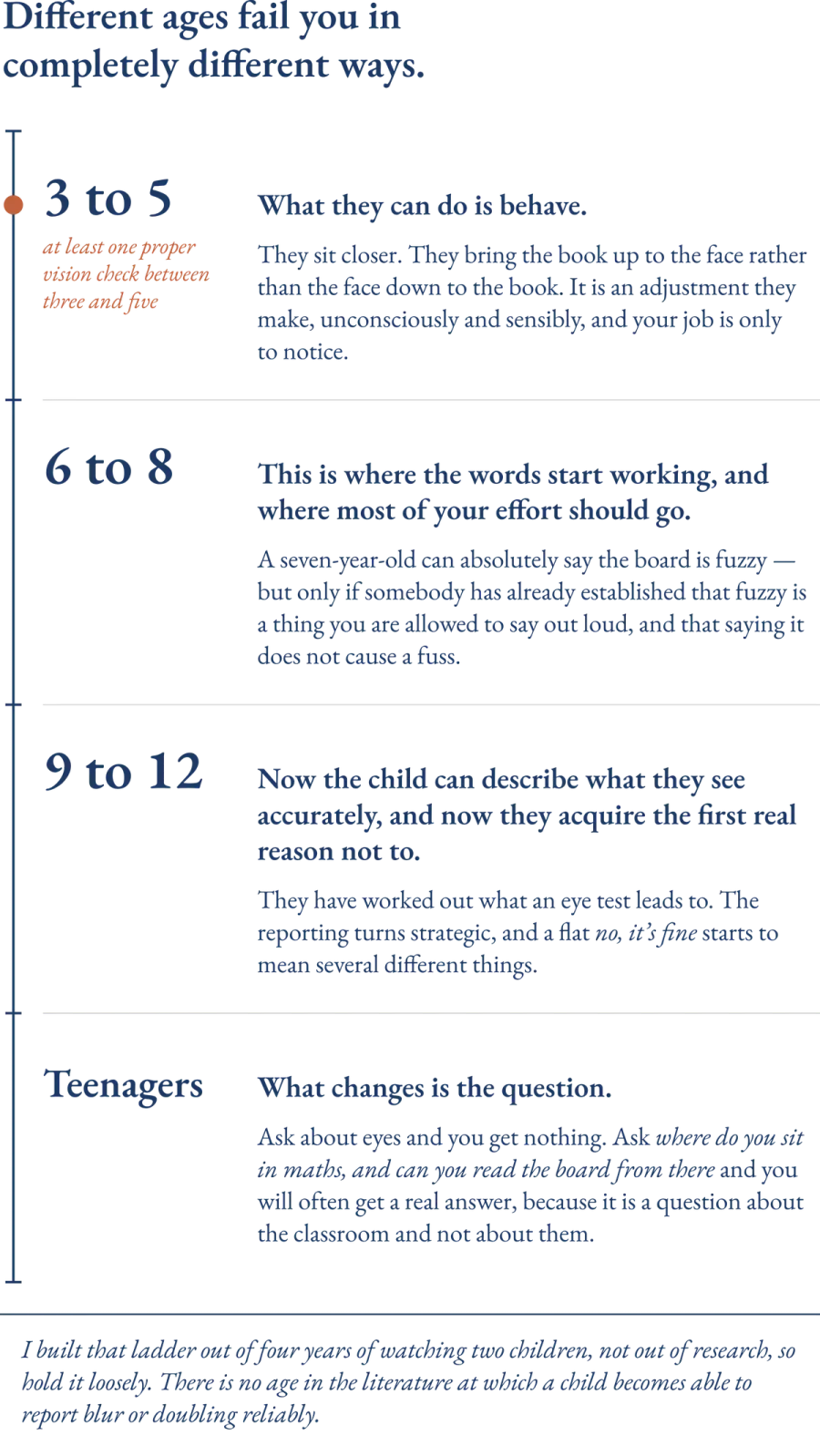
I am a father, not an optometrist, and neither of my children has needed glasses; what I have is four years of reading and many conversations with parents who did sit in the optician’s chair.
Why the glasses have to be on all day, not just for the board
The whole argument in one sentence: glasses are not the loss. The losses are a pair that is not being worn, a lesson that cannot be seen, and a child who has quietly decided something about themselves, and those three feed each other.
A lens moves the picture back onto the retina. It does nothing to the length of the eye, so glasses neither cause short-sightedness nor cure it. That makes the frames the least informative thing in the room. What repays watching is whether they are on, whether your child can see what is being taught, and what they have concluded about themselves meanwhile.
One rule follows, and it is the international guidance: the prescription is to be worn in full, and for most children that means all day rather than only for board work and reading.2 Evidence: STRONG The old idea of a deliberately weak pair so the eyes “have to work” was tested, and it backfired: children under-corrected by three quarters of a dioptre progressed faster than children given their full prescription.2 Evidence: STRONG The correction is not a crutch that weakens an eye. It is the only reason any of this helps. The mechanics are in the myopia-in-children hub.
What blur actually costs at a desk
There is a famous number about learning and eyesight that I have left out, because nobody can source it. What has actually been measured is smaller and real.
In a group of Baltimore schools, researchers gave spectacles to the children who needed them and looked at reading scores. After a year, reading had improved: by a small amount across everybody, and by about three times that in the weakest readers. After two years the improvement had not held.3 Evidence: MODERATE Other trials that gave children free glasses found the same modest shape.4 Evidence: MODERATE
The link is real, and the effect sits where you would expect if what you removed was an obstacle: with the children furthest behind. The part that faded is why I trust the study. Glasses are not an education strategy. A child who cannot see the board is learning with one hand tied; untie it and they do better. They do not become a different child.
So when a seven-year-old leaves the glasses in the bag for a term, the cost is a term of lessons watched from inside a blur. That is worth being firm about, and being firm looks nothing like a row.
The four reasons a pair stops being worn
The reasons are boringly few, and each has a different answer.
They hurt, or they slide. Behind the ears, on the bridge, down the nose all morning so the child spends the day looking over the top of their own correction. Children rarely report this as pain; it comes out as I don’t like them. Adjustments are usually free and take five minutes. Take them back, the third time as well, and stop apologising for it. Comfort decides wear more reliably than anything you can say.
They look wrong to them. Which means the frame choice went wrong, and it is worth the price of putting that right rather than the price of a year of non-wear.
Sport. A real incompatibility with a real answer, below.
“I can see fine.” The most dangerous one, because it is usually sincere. A child who has adapted to blur is not lying. A seven-year-old has one experience of the world and no standard to hold it against; whatever they see is what seeing looks like. This is not an argument to win. It is a reason to have the eyes looked at again, because it can mean the prescription has moved, or was never quite right, or that one eye has quietly taken over. Evidence: EXPERIENCE
That is why I would stop asking how are your eyes; the question is broken for a child with nothing to compare against. What works is a fixed thing at a fixed distance, a house number across the road or the sign on the corner shop, and the question can you still read that one, with and without. For the first time, a child may feel what the lenses do, because you have given them a before and an after. There is more on teaching a child to tell you the world is blurry.
Let them choose the frames, and then say almost nothing
Every parent asks about teasing in the shop, usually while pretending to look at frames. The honest answer is not “no”. In a British cohort of more than six thousand children, those who had worn glasses or an eye patch were roughly a third more likely to report having been bullied.5 Evidence: MODERATE It is one cohort, self-reported, and it cannot separate the glasses from everything else about a child who needs them, but it is real.
Now the half nobody mentions. When children aged six to ten were shown photographs of other children, the same child with and without spectacles was rated as cleverer, and as more honest.6 Evidence: LIMITED Glasses are a marker, and markers cut both ways: the child in the frames is slightly more likely to be teased and is also being read as the clever one, often by the same nine-year-olds on the same afternoon. The teasing article covers what to do when it is actually happening.
Three practical moves, and the first matters most.
Let your child choose the frames. Set the budget, let the optician set the shortlist of what fits, then hand the decision over completely, including when they pick the pair you were hoping they would not. A child who chose their own glasses is defending a decision they made. A child who was handed a pair has only something to resent, and resentment is what ends up in the bag.
Say very little at home, and say it once. Elaborate enthusiasm does not land, because children can hear effort. Nor does the superpower framing; it works on some five-year-olds and collapses on any nine-year-old, because it announces that something needs compensating for. Treat them like furniture. The one thing worth saying is factual: name the people in the family who already wear glasses, in passing, once.
Tell the teacher, and ask for two things. Seating, because a child with a new prescription may still want the front for a term. And information: ask to be told privately if there is teasing, and whether the glasses are on during lessons. Not a class discussion about your child’s eyes.
Sport is the one place “I’ll take them off” is reasonable, so plan for it
Ordinary spectacles are not protective equipment. They were designed to hold a lens in front of an eye, not to take a netball or an elbow, and I’ll just take them off for PE is how a child watches two terms of lessons from inside a blur.
For most school sport the answer is a second pair with a sports frame and a strap, kept in the kit bag. For anything with a small fast object or a stick, it is purpose-made eye protection worn over the correction. The American paediatricians and ophthalmologists said so jointly in 2004: protective eyewear for every child playing a sport with a risk of eye injury, and mandatory for a child with useful sight in only one eye. Ask for a protector tested to the American Society for Testing and Materials standards, with shatterproof polycarbonate lenses; the games they name are basketball, racquet sports, football and hockey.7 Evidence: STRONG That is the one piece of equipment I would buy without waiting for another study.
On contact lenses, there is no birthday, only a short list of things a child has to do reliably and unsupervised; the myopia-control hub covers the lenses that also slow the growth of the eye.
The child who is genuinely upset
Most children are fine, and I want that said first. Among families whose children were prescribed patching for a lazy eye, around three quarters of parents reported real difficulty, and the children were markedly more distressed by the patch than by the glasses.8 Evidence: MODERATE Of the things we ask children to wear on their faces, spectacles are the easy one. Most will be over it by the second week.
But not all. If your child is genuinely upset, stop reassuring. You look great, it’s fine is a door closing. You hate them. Which bit? is a door staying open, and the answer is often something specific and fixable: a particular boy, the arms catching their hair, a teacher who announced it to the class. Evidence: EXPERIENCE
Do not stage it with a celebration or a photograph unless you have asked which yours would prefer; for a five-year-old it may be lovely and for a nine-year-old it is a spotlight. And do not bribe. What helps is handing back the control that is genuinely available: which pair goes on today, where the case lives. A child treated as a person with preferences rather than a face with a problem.
And the line where this stops being about eyes: if your child has dropped things they used to like, if the reluctance has spread into school itself, or if the flatness has lasted weeks rather than days, the glasses are no longer the subject. That is a conversation with your doctor or the school, and it is easier early.
What I would do in the first month
- Hand the frame choice to your child inside a budget and a shortlist that fits, and buy the pair they pick even when it is the pair you dislike.
- Take any pair that pinches, slides or keeps getting left behind straight back to be refitted, as many times as that takes.
- Pick one fixed thing you pass most days and ask, once, whether they can read it with the glasses and without, so the child has a before and after of their own.
- Ask the teacher two questions each term: where your child is sitting, and whether the glasses are actually on during lessons.
- Buy the second pair for sport, and proper eye protection for anything with a small fast ball or a stick.
- If “I can see fine” persists, book the follow-up appointment rather than the argument. Short-sightedness starts at about half a dioptre and it moves.9 Evidence: STRONG
Somewhere this afternoon a child will step out of an optician’s in glasses for the first time and stop on the pavement, because the tree at the end of the road has individual leaves on it. Nobody at school will be looking at the frames by Thursday. The only face worth watching is the one underneath, and it is not sad. It is busy.
Sources
- Dhirar N et al. BMC Ophthalmol 2020;20:71 (pooled compliance 40.1%) · Evans JR et al. Cochrane Database Syst Rev 2018;CD005023 (free spectacles, RR 1.60 for wearing). Link
- Chung K et al. Undercorrection of myopia enhances rather than inhibits myopia progression. Vision Res 2002;42(22):2555–9 · Gifford KL et al. IMI Clinical Management Guidelines Report. IOVS 2019;60(3):M184–203. Link
- Neitzel AJ et al. JAMA Ophthalmol 2021;139(10):1104–14. Reading effect size 0.09 at one year overall and 0.28 in the lowest-performing quartile; "a sustained impact was not observed after 2 years". Link
- Ma X et al. BMJ 2014;349:g5740 — free spectacles improved test scores by about 0.11 standard deviations.
- Horwood J et al. IOVS 2005;46(4):1177–81. 6,536 children in the ALSPAC cohort; 35–37% higher likelihood of being bullied among those with a history of glasses or patching. Link
- Walline JJ et al. Ophthalmic Physiol Opt 2008;28(3):218–24. Link
- American Academy of Pediatrics Committee on Sports Medicine and Fitness; American Academy of Ophthalmology Eye Health and Public Information Task Force. Protective eyewear for young athletes. Pediatrics. 2004;113(3 Pt 1):619–622. PMID 14993558. Link
- Hrisos S et al. Ophthalmology 2004;111(8):1550–6. Link
- Flitcroft DI et al. IMI — Defining and classifying myopia. Invest Ophthalmol Vis Sci 2019;60(3):M20–M30. Link
Drawn from Chapter 16 and Chapter 11 of Children's Eyesight Problems, second edition. Report a correction.