Books and tablets beyond 30 centimetres (12 inches), with 30 to 40 the comfortable range. Laptops and desktops at 50 to 70 centimetres (20 to 28 inches). A break every 20 to 30 minutes. Those are the only three numbers worth memorising, and the first you can check from the doorway: 30 centimetres is roughly the distance from a child’s elbow to their knuckles. If the tablet is inside the forearm, it is too close.
I am a father who spent four years reading about children’s eyes, not a doctor. What took me longest to understand is that the researchers never asked the question I was asking: how many hours is too many.
Nobody counts hours. They count hours times closeness.
When researchers pooled the studies on near work and short-sightedness, the association was there but modest: roughly 14 per cent higher odds, nowhere near the size of the thing parents fear.1 Evidence: MODERATE If reading hours were the engine, that number would be enormous.
Look at the unit those researchers used, though. They counted dioptre-hours, which multiply how long the child worked by how close the work was held. An hour with the page at 33 centimetres counts for three times as much as an hour at a metre. Distance was built into the arithmetic from the start. So near work is not one dial but three: how close, how long without stopping, and how often the child looks up.
The best single study followed more than 10,000 schoolchildren in Taipei for two years. Children who kept their work beyond 30 centimetres progressed by about −0.70 dioptres over the two years; the ones who held it closer, about −1.04. Children who stopped every half hour came out at around −0.77, against −0.96 for the ones who did not.2 Evidence: MODERATE Nobody in either group got better. The difference is the speed, and the speed is what you get to influence. Two habits, about a third of a dioptre each, from the width of a table.
A second, smaller snapshot study points the same way: children who read continuously for more than 45 minutes had about 40 per cent higher odds of being short-sighted, and so did the ones who habitually read at 20 centimetres or less.3 Evidence: LIMITED I would not build a household rule on it alone. All of this is association, not a trial; children who sit back from their books probably differ in ways that go beyond furniture. But dioptres a child never acquires are permanent, and this is the dial a parent can actually turn.
A tablet is a book you hold closer
The biggest summary we have pooled 45 studies and more than 335,000 people and found that each extra hour of daily screen time went with about 21 per cent higher odds of short-sightedness; at one hour a day the odds barely moved, at four hours they were close to double.4 Evidence: MODERATE Then a birth-cohort study followed children to age nine and found that reading and writing predicted who became short-sighted, while screen time was not statistically significant at any age.5 Evidence: MODERATE Two good studies pointing in opposite directions. The book’s evidence table calls it disputed.
The only way I have found to hold both results at once is this: a tablet is a book you hold closer, for longer, with no end of the chapter. Run it through the three dials. How close: a phone lives at about 20 centimetres, a book at 30 to 40. How long: a book has page numbers, chapters and an ending, and a feed is built not to have them. How often you look up: the content is engineered so that you do not. The screen is not a separate poison. It is the most efficient delivery system for near work ever invented. The wider argument is in the screens hub and the article on screen time.
So the distance rule is the same for a tablet as for a book: beyond 30 centimetres, in the forearm check. The fight is almost entirely with handheld devices; a television across a room is not near work, and the further away a screen can be, the better. Distance is free.
On hours by age, the book gives only two numbers, from the World Health Organization: under two, none; two to four, up to an hour a day and less is better.6 Evidence: MODERATE For school-aged children it gives none, and since February 2026 neither does the American Academy of Pediatrics, which called the traditional notion of screen time “just the tip of the iceberg”.7 The useful questions are what, when, and instead of what.
Why distance matters more than strain, and why the laptop number is different
You will read everywhere that holding things close strains the focusing muscle, and that the strain makes the eye grow. The measurements do not support it. When researchers followed children through the years around their onset, the focusing error called accommodative lag rose after they became short-sighted, not before.8 Evidence: MODERATE The strain is a passenger, not the driver. What the growing eye appears to respond to is the picture landing on the back of it; in animals, a lens in front of a growing eye makes it lengthen to meet the blur.9 Evidence: LIMITED The eye reads the image, not the effort, and distance sets the image.
Which tells you why the laptop number is a different kind of number. The 30 centimetres for books and tablets comes out of the Taipei study. The 50 to 70 centimetres for laptops and desktops comes from ergonomics: the distance at which a screen of that size is comfortable for an hour. Nobody has shown that moving a laptop from 45 centimetres to 60 changes how an eye grows. It is comfort advice. Evidence: LIMITED
Tired eyes are not growing eyes. Digital eye strain in school-aged children has been measured at between 45 and 64 per cent, though those figures come from the period when classrooms moved onto screens, so treat them as the high-water mark.10 Evidence: MODERATE It is real, worth fixing, and gone by morning. The ache is not a warning light for the millimetre.
The chair is a lever on the distance
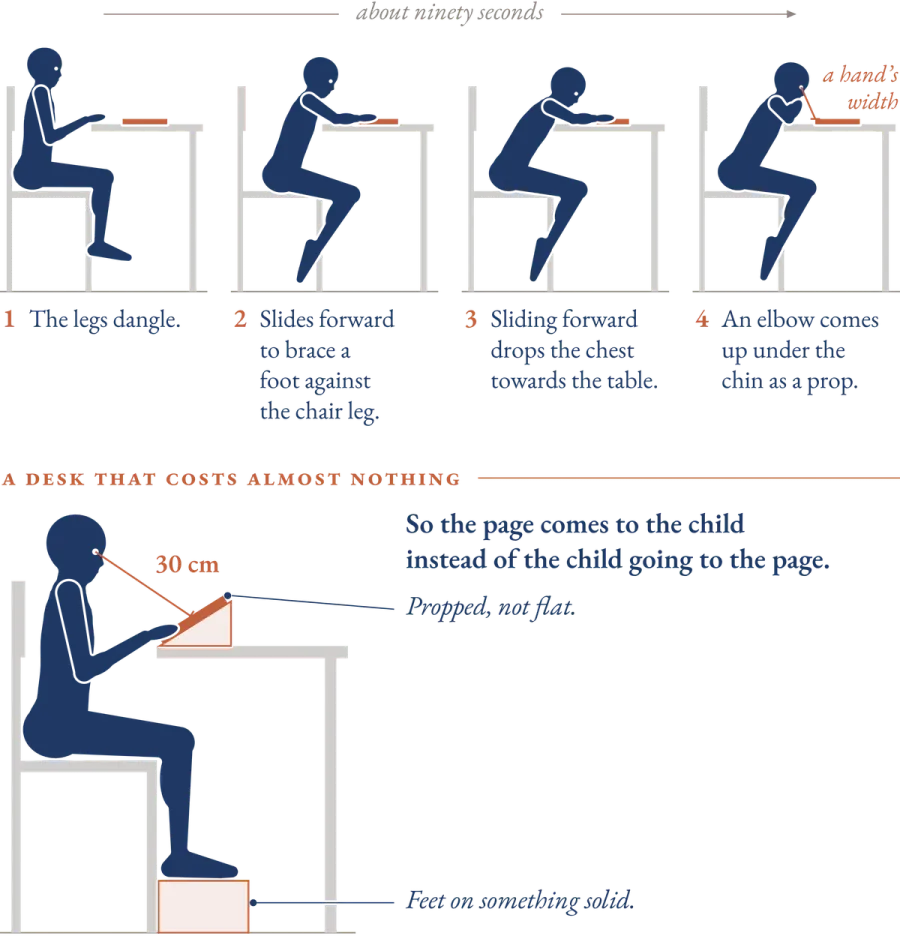
Here is the part I missed for a year while saying sit up straight two thousand times. A child’s feet, at a table built for adults, hang. The child gets tired of dangling and slides forward to brace a foot against the chair leg. The chest drops towards the table, the head follows, an elbow comes up under the chin, and the book ends up a hand’s width from the face. About ninety seconds. Nobody decided to read at fifteen centimetres. The room decided.
A child’s back does not affect their eyesight. But a child’s back decides how far the page sits from their eyes, and that distance does. So the chair is a lever on the working distance. I should label this honestly: it is a chain of reasoning, not a finding. The measurement at one end is real; the observation at the other any parent can make in ninety seconds. Nobody has tested the chair in between. Evidence: EXPERIENCE
Everything that follows can be done this evening with things already in the house. Start at the floor, not the head: the feet need something solid underneath them, a box, a stack of old books, an upturned crate. Then the table, with elbows at roughly a right angle; if the table cannot move, a firm cushion raises the child. Then the screen, top at or just below eye level; a laptop is two pieces of equipment bolted together at the wrong angle, so raise it on books and add a cheap separate keyboard. Then the book, propped on a ring binder, a cookbook stand or a folded towel, so the page comes to the child instead of the child going to the page.
Ninety minutes is not a homework block, it is a dose
Screens take the blame. Homework does the hours. Homework is the near work you cannot argue with, and the birth-cohort study found its strongest signal in reading and writing, not screens.5 So: not less homework. Differently shaped homework.
A ninety-minute block is a dose delivered in one go, at whatever distance the child drifts to, which after about twenty minutes is always closer than it started. Break it into three: twenty-five minutes of work, three or four minutes of something else, twenty-five more, then a longer break outside if there is any light left. The break cannot be a different screen; the phone is the same dial at a shorter distance. Two things that cost nothing: have the child read a paragraph aloud to someone across the room, so the head comes up and the eyes work at four metres; and hand the timer to the child, a wind-up kitchen timer rather than a phone, so the half hour stops being a negotiation.
The break every 20 to 30 minutes is the habit with the Taipei evidence behind it. The twenty-seconds-looking-far part of the famous rule has been tested in 29 adults, where it improved symptoms and nothing measurable, and the benefit was gone a week after the reminders stopped.11 Evidence: LIMITED It makes eyes feel better; it is not a myopia treatment. The 20-20-20 rule has its own article.
Light does not act on the eye at the desk. It acts on the distance.
Aim for a task lamp putting about 300 to 500 lux on the page, from the side away from the writing hand, and never a single bright lamp in a dark room. That advice is not myopia prevention. One classroom study relit rooms and reported about 4 per cent of children becoming short-sighted against about 10 per cent in ordinary rooms,12 Evidence: LIMITED but that was an entire ceiling, not a lamp, and the international group that reviews the field said in 2025 that the literature does not yet support guidelines on the characteristics of light.13 Evidence: MODERATE The brightness that brakes eye growth is outdoor brightness, around a thousand lux and above in the school trials,14 Evidence: MODERATE roughly twice the brightest reading lamp you will ever set up. That light belongs to the daylight hub.
So why bother with the lamp? Because a child reading in a dim room leans in, and so does a child reading through a reflection on a screen. They bring their face closer until the words resolve, and stay there. The lamp is a lever on the distance, and on the headache at seven o’clock.
One rule overrides everything above. Leaning in is a reason to book an eye test, not a reason to move the lamp. If a child is squinting, sitting closer and closer, covering one eye, tilting their head, or coming out of homework with headaches, that is not a chair problem. Book the appointment first. The desk cannot see.
Five things to change before tomorrow’s homework
- Put something solid under their feet tonight, a box, a crate, a stack of books, so the legs stop swinging.
- Prop the book on a slope and raise the screen to eye level, so the page comes to the child instead of the child going to the page.
- Set the two distances and then leave them alone: books and tablets beyond 30 centimetres, laptops and desktops at 50 to 70. Check the first from the doorway, elbow to knuckles.
- Move the lamp to the side away from the writing hand, and switch on a second light so nobody is staring at a bright screen in a dark room.
- Retire sit up straight and replace it with one question, can you still read it sitting back? If the answer is honestly no, book an eye test rather than adjusting the chair.
Sources
- Huang HM, Chang DS, Wu PC. PLoS One 2015;10(10):e0140419. Link
- Huang PC et al. Br J Ophthalmol 2020;104(7):956–61. Link
- Li SM et al. PLoS One 2015;10(8):e0134514. Link
- Ha A et al. JAMA Netw Open 2025;8(2):e2460026. Link
- Wu F et al. Acta Ophthalmol 2026;104(3):e337–45. Link
- WHO guidelines on physical activity, sedentary behaviour and sleep for children under 5 (2019). Link
- Munzer T et al. Digital ecosystems, children, and adolescents: policy statement. Pediatrics 2026;157(2):e2025075320. Link
- Mutti DO et al. Accommodative lag before and after the onset of myopia. IOVS 2006;47(3):837–46. Link
- Troilo D et al. IMI — Experimental models of emmetropization and myopia. IOVS 2019;60(3):M31–M88. Link
- Song F et al. J Glob Health 2026;16:04053. Link
- Talens-Estarelles C et al. Cont Lens Anterior Eye 2023;46(2):101744. Link
- Hua WJ et al. Ophthalmic Physiol Opt 2015;35(3):252–62. Link
- Ashby R et al. IMI — The role of light in refractive development and myopia. IOVS 2025;66(15):5. Link
- Wu PC et al. Ophthalmology 2018;125(8):1239–50. Link
Drawn from Chapter 5 and Chapter 6 of Children's Eyesight Problems, second edition. Report a correction.