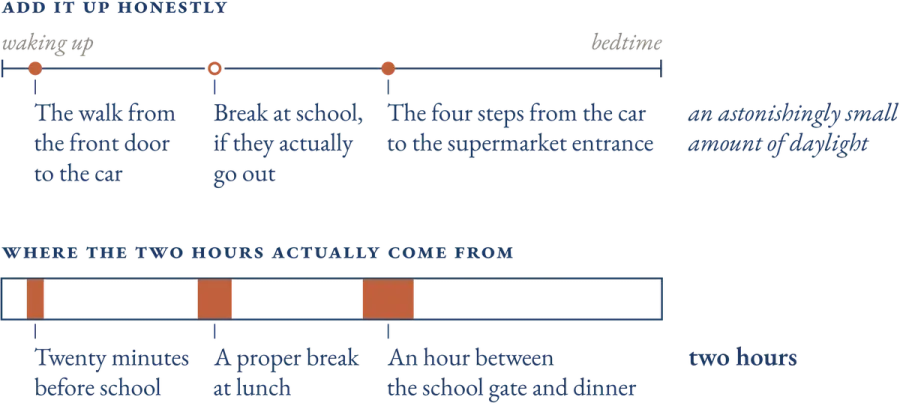
Around two hours a day outdoors, in whatever weather your country gives you, is the strongest thing a parent can do to stop short-sightedness starting — and it is far better at stopping it than at slowing it down once it has begun. It does not have to be sport, it does not have to be sunny, and it does not have to arrive in one block. It has to be outside, under the open sky, because the thing doing the work is not the view or the exercise. It is the sheer brightness of daylight falling into a growing eye.
That second half is the part nobody puts on the poster, and I will come back to it. I am a father who read about eyes, not a doctor, and the rest of this page is what the trials actually found and what we changed in our house because of them.
Two hours, and not two hours of sport
Start with the number, because parents want the number. When researchers pooled 31 studies covering some 380,000 children, more than two hours a day outdoors was where the odds of becoming short-sighted dropped meaningfully — by around a quarter.1 Evidence: STRONG Two hours is not magic; it is the point where the benefit is big enough to be worth reorganising a week around.
It is also a slope rather than a switch. In one dose-response analysis, an hour a day was already associated with roughly a fifth lower odds of it starting, and a bit over two hours with about half.2 Evidence: MODERATE Nobody has to go from nothing to two hours by Thursday. Every additional twenty minutes is doing something.
What convinced me was what the trials actually did. In Guangzhou, researchers added forty minutes of outdoor time to the school day and followed the children for three years. About 30 per cent became short-sighted, against about 40 per cent of the children whose day was left alone.3 Evidence: STRONG Forty minutes. One class, moved outdoors.
In Taiwan, another team did something even smaller. They did not add any time at all. They took the break the children were already having and required it to happen outside instead of in the classroom. Over the following year, roughly one child in twelve became short-sighted in those schools. In the schools that changed nothing, it was about one in six.4 Evidence: STRONG
Read what the researchers changed. Not the fitness, not the homework, not the screens. In the Taiwanese trial they did not even change the timetable. They changed the location. A child who plays football for two hours in a sports hall gets none of this. A child who sits on a wall for two hours arguing with a friend gets the lot. You do not need a club, a kit or a coach. You need a door.
Nor does it have to come in one piece. Twenty minutes before school, a break at lunch and an hour between the school gate and dinner count exactly the same as two hours in a park — a weekly dose built out of edges.
It is the light, and nobody is quite sure why
The reason location is the whole variable is brightness, and the size of the gap between indoors and outdoors is something most parents have never been shown. When a Singapore group went out with a light meter, a typical indoor room sat at roughly 112 to 156 lux. Outdoors ran from about 11,000 to 18,000. In the shade of a tree it was still around 5,500 to 7,900; under a hat about 4,100 to 8,200; and even wearing sunglasses a child got somewhere between 1,800 and 6,800 — dozens of times more light than sitting by a window indoors.11 Evidence: MODERATE
Where does the bar sit? When a Taiwanese team measured what children were actually getting and compared it against who became short-sighted, the protective exposure was time in light above roughly a thousand lux — and the researchers concluded that strong sunlight was not necessary to reach it.5 Evidence: MODERATE The shade of a tree clears a thousand lux without trying. So does a bus stop, or a grey afternoon.
So here is the only rule I have ever needed: if your child can see the sky, it counts. Through glass, it does not. A conservatory, a sunny car journey, a shopping centre with a glazed roof — all feel like daylight and none of them are.
Can you simply buy the light instead? One Chinese trial relit classrooms and reported that about 4 per cent of children became short-sighted against about 10 per cent in ordinary rooms — but it is a single preliminary result, and what was changed was an entire ceiling of an entire room, not a lamp on a desk.6 Evidence: LIMITED Nothing you can plug in at home approaches what a cloudy day gives you for free.
Now the honest part. Nobody can tell you exactly why bright light protects a growing eye. The explanation you will see everywhere is dopamine — bright light makes the retina release it, and it acts as a stop signal for lengthening. There is real work behind this: in chicks, bright light protected eyes fitted with a lens designed to make them grow too long, and when the dopamine pathway was blocked, the protection disappeared.7 Evidence: LIMITED It is an elegant experiment. It was done in chicks.
The international group that reviewed all the light research put it carefully at the end of 2025: bright light behaves like a brake on eye growth, but the literature “does not yet support evidence-based guidelines concerning specific characteristics of light exposure”.8 Evidence: MODERATE When someone tells you confidently that morning light is the important kind, they are telling you something nobody currently knows. I find this reassuring: the trials sent children outside without knowing why it worked, and the children’s eyes still did better.
One shortcut deserves killing off, because I fell for it in print in the first edition of my book: vitamin D. When one cohort study separated the two, time outdoors predicted who stayed clear and the vitamin D level, on its own, did not reach significance.9 A genetic test of the direction of cause put the effect at essentially zero.10 Evidence: MODERATE Vitamin D is a passenger in the car. Do not let the bottle stand in for the hour outside.
Rain counts. Shade counts. The hat counts
The question parents ask most is never about the time. It is skin. You do not have to choose between the two. The people who measured those light levels said so themselves: what they recommend is outdoor time taken with proper sun protection.11 A wide-brimmed hat does not cancel the benefit. Sunglasses do not cancel it. Sunscreen has no effect on it whatsoever. Deep shade under a tree, an awning, the north side of a building — all still deliver many times what your living room does. Follow your own country’s sun advice rather than mine: if it says keep out of direct sun between eleven and three, take the two hours early, late, or in the shade. None of it costs you the light.
One rule is not negotiable, and it has nothing to do with short-sightedness: nobody looks at the sun. Not for a dare, not through sunglasses, not through a phone camera, and not during an eclipse. In one series of three children aged eight to eleven who had stared at an eclipse or a transit of Venus, scans showed the light-sensing layers at the centre of vision disrupted, and in some eyes the damage was still there months later.12 Evidence: LIMITED Three of them was enough for me.
Rain is not a problem. Grey is not a problem. Cold is a clothing decision. The problem is real winter. Every trial I have described ran in Taiwan or southern China; nobody has run this study in a Norwegian February, and the dose in a dark winter is not known. What the evidence obliges you to do is stop spreading the daylight thinly and defend the middle of the day. In December, lunchtime is the whole game.
If it has already started, this is not your treatment
Outdoor time is a preventer. Its power is concentrated almost entirely in the period before a child becomes short-sighted. When reviewers looked specifically at children whose eyes had already started to lengthen, the effect that shows up so clearly for onset did not carry through into slowing progression.13 Evidence: MODERATE Even the Cochrane review that produced the prevention figures rated the evidence on progression as low certainty and said conclusions were difficult to draw.14
That does not mean outdoor time is useless for a short-sighted child; “not proven to slow it” is not “proven to do nothing”. It means outdoor time is not the treatment. If your child came home last month with a first prescription, the thing that slows an eye already lengthening is in myopia control — drops, particular contact lenses, particular spectacle lenses, all with trial evidence behind them — and the worst thing you can do is spend a year hoping the park will be enough before you ask about them.
Keep the two hours anyway, especially for the younger sibling, who is very probably still on the right side of this line. And one line overrides everything here: habits do not detect a problem. If something about your child’s sight has changed, book the appointment first. The daylight comes after.
Where the two hours actually come from
I could not find two free hours in our day. Nobody can. So we stopped hunting for a block of time and started collecting edges: the twenty minutes before school, the walk instead of the drive, the hour after the gate and before the homework, a weekend morning booked like a dentist’s appointment, and homework done on the step when the weather allows.
Two harder cases. Children who grow up in cities carry about two and a half times the odds of becoming short-sighted, in one large review.15 Evidence: MODERATE In a flat, the two hours have to be an appointment rather than an opportunity: one adult, one destination, the same time each day. A balcony with open sky above it counts; a stairwell window does not. And the child who hates being outside is usually not talking about the outdoors — it is cold hands, boredom, or that nobody they like is out there. “Come with me to get the bread” beats “go outside and play” every time.
Five things to change this week
- Take the twenty minutes before school tomorrow morning, before anything else in the day can spend them.
- Swap one car trip a day for the same trip on foot, and leave it that way whether or not anyone is enthusiastic.
- Send the reading, the homework and the snack outside whenever the weather allows, and stop worrying about what they are looking at while they are out there.
- Book one long outdoor morning into the weekend the way you would book a dentist, and defend it.
- Send them out in a hat, sunglasses and sunscreen rather than keeping them in — shade and cloud and grey all count, and the only thing that does not count is being behind glass.
We stopped asking whether we had time to go outside and started treating the daylight as the fixed thing in the day, with everything else arranged around it. You are not looking for two free hours. You are looking for the door.
Sources
- Dai J et al. Exposure-response association between outdoor activity time and myopia risk in Chinese children and adolescents. J Glob Health. 2026;16:04122. Link
- Li D et al. Ophthalmic Res. 2024;67:393–404.
- He M et al. Effect of time spent outdoors at school on the development of myopia among children in China: a randomized clinical trial. JAMA. 2015;314(11):1142–8. Link
- Wu PC et al. Outdoor activity during class recess reduces myopia onset and progression in school children. Ophthalmology. 2013;120(5):1080–5. Link
- Wu PC et al. Ophthalmology. 2018;125(8):1239–50. Link
- Hua WJ et al. Ophthalmic Physiol Opt. 2015;35(3):252–62. Link
- Ashby RS, Schaeffel F. The effect of bright light on lens compensation in chicks. Invest Ophthalmol Vis Sci. 2010;51(10):5247–53. Link
- Ashby R et al. IMI — The role of light in refractive development and myopia. Invest Ophthalmol Vis Sci. 2025;66(15):5. Link
- Guggenheim JA et al. Invest Ophthalmol Vis Sci. 2014;55(12):8550–8. Link
- Cuéllar-Partida G et al. Int J Epidemiol. 2017;46(6):1882–90. Link
- Lanca C, Teo A, Vivagandan A, et al. The effects of different outdoor environments, sunglasses and hats on light levels: implications for myopia prevention. Transl Vis Sci Technol. 2019;8(4):7. Link
- Gregory-Roberts E, Chen Y, Harper CA, Ong T, Maclean MA, Fagan XJ, Carden SM. Solar retinopathy in children. J AAPOS. 2015;19(4):349–351. · American Academy of Ophthalmology. EyeWiki: Solar retinopathy. Updated 21 July 2026. Link
- Xiong S et al. Time spent in outdoor activities in relation to myopia prevention and control: a meta-analysis and systematic review. Acta Ophthalmol. 2017;95(6):551–66. Link
- Kido A, Miyake M, Watanabe N. Interventions to increase time spent outdoors for preventing incidence and progression of myopia in children. Cochrane Database Syst Rev. 2024;6:CD013549. Link
- Rudnicka AR et al. Br J Ophthalmol. 2016;100(7):882–90. Link
Drawn from Chapter 4 of Children's Eyesight Problems, second edition. Report a correction.