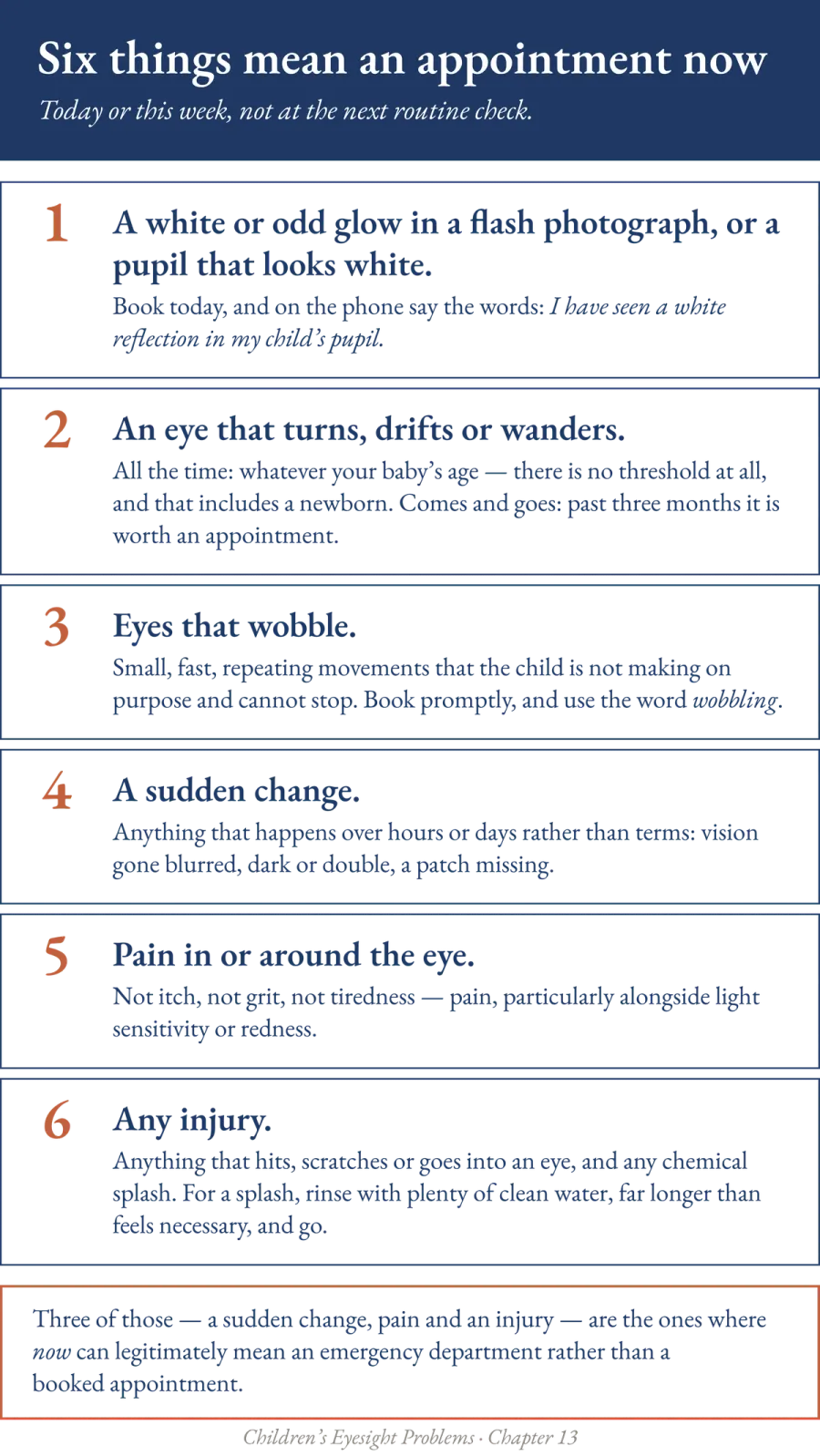
Book the appointment first. If you are reading this because you have seen something in your child’s eyes that worried you, that is the whole answer, and the rest of this page is about how quickly to book and what to say on the phone. Six things mean today or this week rather than the next routine check: a white or odd glow in a pupil, an eye that turns or drifts, eyes that wobble, a sudden change in what they can see, pain in or around the eye, and any injury. Everything else parents notice — the squinting, the chair creeping towards the television, the headaches after school — is quieter, less reliable, and means the same thing on a slower clock: book a proper eye examination, and do not try to fix it with a lamp first.
I am a father, not a doctor. I got some of the first edition of my book wrong, and this list is the page of the second I would keep on my phone.
The six signs that mean this week, not next term
A white or odd glow in a flash photograph, or a pupil that looks white. You take hundreds of photographs of your child, and in almost all of them both pupils come back the same red. If one ever comes back white, yellow or simply not matching its partner — in one photograph or across several — that is an appointment, and not one for next month.3 Evidence: STRONG Book today, and on the phone say the words: I have seen a white reflection in my child’s pupil. The clinical guidance on the rarest and worst of the conditions behind that glow tells the examining doctor to ask parents outright whether they have seen a white pupil or a turned eye, and treats any abnormal red reflex in a child as an immediate referral to a specialist in children’s eyes.4 Evidence: STRONG The specialist’s own procedure depends on what you have already noticed. It is not always something. But it is not the kind of not-always a parent settles at the kitchen table.
An eye that turns, drifts or wanders. Two limbs to this one, and the age belongs to only one of them. A squint that is there all the time should be looked at whatever the child’s age — there is no threshold, and that includes a newborn. A squint that comes and goes is common in the first three months and usually settles, but past three months it is worth an appointment rather than another fortnight of watching.7 Evidence: STRONG It does not have to be there every time you look. In, out or up; constantly, or only when tired, or only in photographs — once is enough.
Eyes that wobble. Small, fast, repeating movements — side to side, up and down, or circling — that the child is not making on purpose and cannot stop. Book promptly, and use the word wobbling; receptionists recognise it.
A sudden change. Anything that happens over hours or days rather than terms: vision gone blurred, dark or double, a patch missing, a child who cannot see what they could see yesterday.
Pain in or around the eye. Not itch, not grit, not tiredness — pain, particularly alongside light sensitivity or redness. A sore eye in a child who is otherwise entirely themselves is a different matter, and the book draws that line in its chapter on comfortable eyes.
Any injury. Anything that hits, scratches or goes into an eye, and any chemical splash. For a splash, rinse with plenty of clean water, far longer than feels necessary, and go.
When “now” means the emergency department
Three of the six — a sudden change, pain and an injury — are the ones where now can legitimately mean an emergency department rather than a booked appointment, and the NHS draws the line in a way worth memorising. After an injury to the eye, any change to your child’s sight, or severe pain in the eye, means A&E or 999 rather than wait-and-see. A sudden loss of sight in one or both eyes, or sudden severe eye pain with no injury at all, is the same call. New blurring, double vision, flashing lights or a shadow moving across the vision is an urgent GP appointment or NHS 111 the same day.8 Evidence: STRONG
Nobody will think you have overreacted, and if somebody does, it is a far cheaper mistake than the other one.
One thing I left off. My first draft had a seventh item: a pupil that has newly stopped matching the other one. It is on plenty of lists, but when I went looking for the guidance that puts it there for a child, I could not find it on the NHS eye or head injury pages. What I found instead was that about one person in five simply has pupils of different sizes, all the time, with nothing wrong.9 Evidence: MODERATE A red-flag list only works if every line has earned its place, so it is out.
Nobody announces that they stopped seeing the board
Now the quiet signs — the ones a parent searching “signs my child needs glasses” is usually looking for — and first, why your child has not simply told you.
A child who can read the board in September and cannot read it in April will not say so, because they do not know. A nine-year-old has no memory of what sharp looked like last term, and today’s world is the only one there has ever been. What a blurring child does instead is adapt — move forward, narrow their eyes, copy from the girl beside them, stop putting a hand up.
The change is also slow enough to hide in plain sight: an eye growing about a tenth of a millimetre a year against one growing two or three tenths. Nobody sees that across a kitchen table. And two eyes make one picture, so a good eye covers for a struggling one completely — including straight through a screening, if each eye is not tested on its own.
The people who study this are blunt about what actually predicts trouble. The International Myopia Institute’s 2025 summary names the best single predictor of a child about to become short-sighted: their refraction, measured with the focusing muscle switched off by drops. Tracking that and the length of the eye together, it says, is the core of managing a child at risk.5 Evidence: STRONG Neither happens at home.
The quiet signs, and the one thing they all mean
What you will actually notice is a set of ordinary, unreliable, easily explained-away things. Sitting closer to the television, or shuffling the chair forward until they are half under the table. Squinting — the real kind, a narrowing of the lids that genuinely sharpens a blurred image for a second or two. Covering one eye, or closing it. Tilting the head to read. Holding the book or the tablet closer than they used to. Headaches at four o’clock and never at eleven in the morning. Losing their place in a line of text. Avoiding close work, or twenty minutes of homework turning into an hour. Rubbing.
Every one of those means the same thing, and it is the thing parents most often get wrong. They mean book an eye examination. Not change the lamp. Not buy a book stand. Not take the tablet away for a fortnight and see. The desk and the lamp matter, but they are what you do for a child whose eyes have already been looked at. A sign is not a problem to solve. It is a reason to be seen.
These signs are also late, and unreliable in both directions. Among preschoolers with uncorrected long sight — children nobody had flagged — early literacy scores came in about four points below their classmates’, and eight and a half points below when near vision was affected too.6 Evidence: MODERATE Those children were not squinting at anything. And the same child can show three signs in a week because they have a cold and stayed up late. If you wait for signs, you are waiting on a system that both misses and cries wolf. That is the argument for a date in the calendar, which the school screening article takes up.
Why I stopped telling parents to test at home
In the first edition I printed an instruction that felt like a key: take your child into a dark room, hold a torch at arm’s length and look at the glow coming back from each pupil. The test is real. It is called the red reflex, and clinicians do it in the newborn nursery and at routine child health visits — which is precisely where the American paediatricians put it.1 Evidence: STRONG What I had done was move it out of a clinician’s hands and into a parent’s.
Then somebody measured what it catches. Against full examinations, the red reflex picked up 99.6 per cent of problems at the front of the eye — and 4.1 per cent of those behind the lens.2 Evidence: MODERATE Behind the lens is where the things a parent lies awake about live. So the torch reassures you about the part of the eye you were not worried about. No paediatric body asks parents to do it. I did, and this page is me taking it back. What replaced it is duller and better: the eyes in the flash photographs I was already taking, and a date in the calendar I do not renegotiate.Evidence: EXPERIENCE
What to say on the phone when the answer is April
Sometimes the appointment offered is months away. Here is what I would do, in order.
Say the specific thing. Describe what you saw in the words of the short list. I have seen a white reflection in one pupil in photographs. Her left eye turns outwards when she is tired. That is triaged differently from “I’m worried about her eyes” — not gaming the system, but feeding it what it runs on.Evidence: EXPERIENCE
Ask for the cancellation list, and say if you can come at short notice.
Ask what it costs before you assume. In many countries children’s eye tests and glasses are free or subsidised and families do not know. Across the studies only about four in ten children prescribed spectacles are actually wearing them, and free provision makes wear roughly 60 per cent more likely.10 Evidence: MODERATE
Take the screening you can get while you wait. A net with holes beats no net.
And if what you are looking at is on the short list of six, stop reading and go. Emergency and out-of-hours services exist for precisely this. What I would not do is wait for the appointment while doing something instead of it. That is how months go missing.
Five things to do before you close this page
- If your child shows any of the six signs, book now — today for a white pupil, a sudden change, pain or an injury — and use the words of the list on the phone.
- If what you have noticed is one of the quiet signs, book a proper eye examination rather than adjusting the lamp, the desk or the screen time, and keep the appointment even if the sign disappears.
- Learn the six by heart; they are the only part of a child’s eyesight that announces itself in time.
- Look at the eyes in your flash photographs, and if one pupil ever comes back white or odd, say so when you ring.
- Set a recurring reminder for the interval the examiner gives you, and stop relying on noticing. What happens in the room tells you what to ask when you get there.
Sources
- Donahue SP, Baker CN et al. Pediatrics. 2016;137(1):e20153597 · Pediatrics. 2016;137(1):e20153596. Link
- Sun M et al. J Pediatr. 2016;179:192–6. Link
- American Association for Pediatric Ophthalmology and Strabismus. Leukocoria (patient information, updated February 2025). Link
- American Academy of Ophthalmology. EyeWiki: Retinoblastoma. Last updated 21 July 2026. Link
- Tahhan N et al. IMI — 2025 Digest. Invest Ophthalmol Vis Sci. 2025;66(12):27 (12 Sep 2025). Link
- Kulp MT et al. Ophthalmology. 2016;123(4):681–9. Link
- NHS. Squint. Page last reviewed 2 May 2023. Link
- NHS. Eye injuries. Page last reviewed 12 March 2026 · NHS. Vision loss. Page last reviewed 28 August 2025. Link
- American Academy of Ophthalmology. What Is Anisocoria? 2 May 2023. Link
- Dhirar N et al. BMC Ophthalmol. 2020;20:71 · Evans JR et al. Cochrane Database Syst Rev. 2018;CD005023. Link
Drawn from Chapter 13 of Children's Eyesight Problems, second edition. Report a correction.